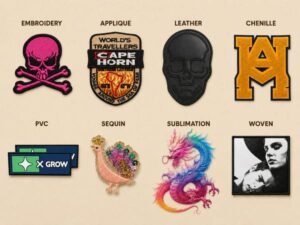
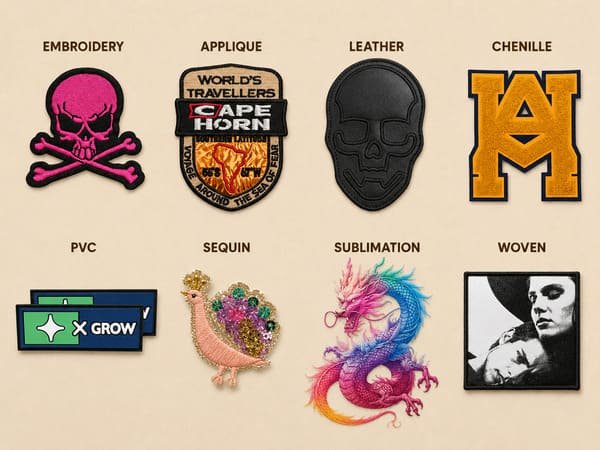
Choosing the right custom patch type can be much easier once you understand what each style is designed to do. The same artwork can create a very different look, texture and overall feel depending on the technique you choose.
In this guide, we’ll walk you through the main types of custom patches and help you decide which one best fits your artwork, intended use and desired effect.
Popular Types of Custom Patches and When to Choose Each
This quick comparison can help you narrow down the options before looking at each type in detail.
| Patch Type | Main Strength | Best For | Main Limitation |
|---|---|---|---|
| Embroidered | Visible thread texture | Logos, uniforms, hats, jackets | Very small, complex details |
| Woven | Fine detail and lightweight feel | Small text, thin lines, detailed logos | Less dimensional texture |
| Sublimated | Full color and gradients | Photos, gradients, complex color artwork | Flat surface |
| PVC | Outdoor performance and Strong dimensional appearance | Backpacks, outdoor gear, rugged products | Very fine details |
| Chenille | Lively and expressive appearance | Varsity, sports, large letters and numbers | Small details |
| Leather | Strong material character | Hats, denim, workwear, outdoor branding | Distinctive material style |
| 3D Embroidery | Raised visual emphasis | Bold lettering and focal elements | Fine, crowded details |
| Appliqué | Special fabrics and large surfaces | Layered and textile-focused designs | Fine details often need another technique |
| Sequin | Decorative visual impact | Performance wear and statement designs | Very small details |
The table is a starting point rather than a fixed rule. The final choice still depends on your actual artwork, finished size and intended use.
Embroidered Patches — Best for Classic Thread Texture
Embroidered patches are one of the most versatile custom patch options. In our production experience, most conventional logo designs can be made with embroidery.
Their main feature is visible stitching. The thread creates a textured, dimensional surface, while different base fabrics and thread types can produce different visual effects.
Embroidery also has physical detail limits. In actual embroidery production, a single-line stitch can achieve a minimum width of approximately 0.3 mm, while a zigzag stitch can achieve a minimum width of approximately 1 mm.
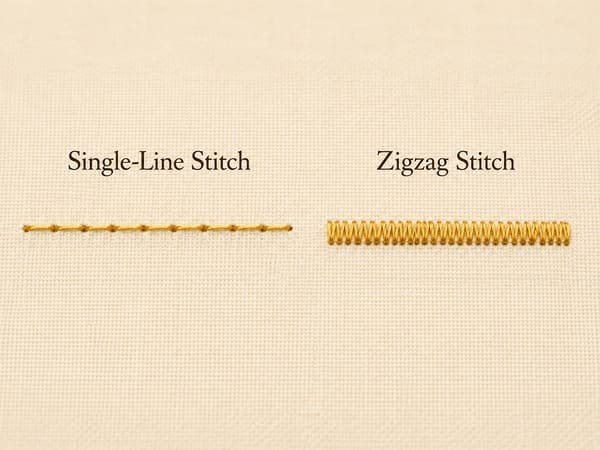
Embroidery also has some limitations in color. For patches around palm size or smaller, we normally support up to 9 thread colors, while larger patches can support up to 18 colors. If your design requires more complex color effects, we recommend combining embroidery with sublimation—a popular combination that keeps the textured look of embroidery while adding richer, more vivid color.
We also need to pay attention to the finished size of the patch. A complex design may look clear when enlarged on a screen, but when it is reduced to a small patch, some details can become too small to remain visible. Too many tiny elements in a limited space may make the finished embroidery look crowded or unbalanced.
Choose embroidery when you want a visible stitched surface, dimensional thread texture and a classic embroidered appearance.
Woven Patches — Best for Fine Details and a Lightweight Finish
Woven patches are especially useful when a design contains fine details that need a thinner, smoother construction.
They are generally lighter, flatter and softer than embroidered patches, making them suitable for:
- small lettering
- thin outlines
- designs where a lightweight finish matters.
The difference between woven and embroidery is not about one being better than the other.
Woven emphasizes clarity, thinness and fine detail, while embroidery emphasizes visible stitching, texture and depth.
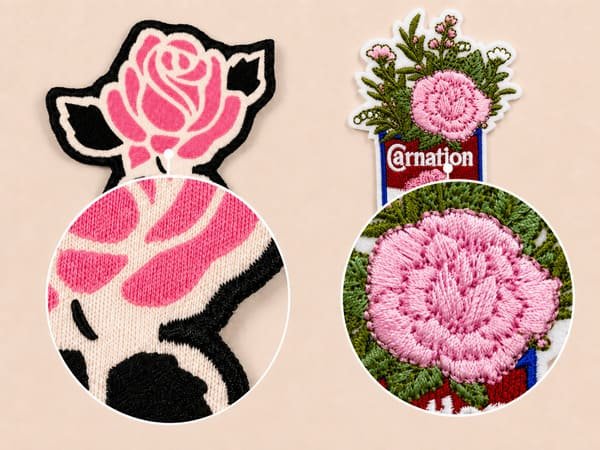
If your design focuses on small text and fine details, woven can keep those elements clearer and more refined. If you want visible thread texture and a more dimensional stitched look, embroidery will highlight those qualities more strongly.
Choose woven when you want fine detail combined with a smooth, thin and lightweight finish.
Sublimated Patches — Best for Full Color, Gradients and Photo-Like Artwork
Some designs are difficult because of small details. Others are difficult because of color.
Sublimation is particularly useful for artwork containing:
- photo-like visual effects
- subtle color transitions
- complex full-color graphics
Its main advantage is color reproduction. When the visual identity of a design depends on rich color or photo-like detail, sublimation can reproduce those effects more naturally than a thread-based construction.
Its surface, remains relatively flat. The visual strength comes from color rather than raised texture.
Choose sublimation when full color, gradients or photo-like detail are the most important parts of your artwork.
PVC Patches — Best for Outdoor and Rugged Applications
PVC uses a molded surface rather than a traditional stitched construction, giving it a smooth appearance and clear dimensional depth.
In our orders, PVC patches are commonly used on camping backpacks, outdoor gear and other products designed for outdoor use. Their water resistance, stain resistance and abrasion resistance make them a practical option for products that may regularly face outdoor conditions.
PVC can be made with different levels of depth. A 2D PVC patch has a flatter, more even surface, while 3D PVC uses different height levels to create a stronger sense of dimension and make selected areas stand out.
In terms of detail limitations, PVC supports a minimum line width of approximately 1.5 mm in our production. If important lines, lettering or graphic details are narrower than this, we may recommend enlarging or simplifying those areas.
Choose PVC when you want strong dimensional visuals together with reliable performance for outdoor use.
Chenille Patches — Best for Bold Varsity and Sports Designs
Chenille is defined by its soft, fuzzy and full surface.
It works especially well for:
- letterman jackets
- large letters
- bold team or club graphics
Its volume naturally suits designs intended to feel energetic and highly visible.
Because chenille yarn occupies more space, it is not designed for very small details. In our production, the minimum achievable width is approximately 5 mm, although different yarns can affect the exact result.
This is also why chenille is often combined with embroidery. Chenille creates the large fuzzy areas, while embroidery handles smaller outlines, facial details or decorative elements.
Choose chenille when bold scale, soft volume and a strong varsity or sports character are central to the design.
Leather Patches — Best for Premium, Vintage and Outdoor Branding
Leather gives a logo a distinctive material character.
It works particularly well for branding that aims to feel:
- premium
- vintage
- outdoor
- rugged
Common applications in our production include outdoor hats, hiking bags, workwear jackets, camping products, denim and streetwear.
Leather patches give a design a distinctive material character and work especially well with premium, handcrafted, vintage and outdoor styles. In our production, they are commonly used on outdoor hats, hiking bags, workwear, camping products, denim and streetwear. The natural texture of leather can also make even a simple logo feel more distinctive and product-focused.
Choose leather when you want the material to communicate premium, vintage, handcrafted or outdoor character.
3D Embroidered Patches — Best for Raised Focal Elements
3D embroidery works best when it is used selectively.
Instead of making every part of a design thicker, the raised effect should emphasize the areas that need the most attention—for example, a brand name, large letter or central symbol.
If you want to add a 3D embroidery effect to your design, keep in mind that lines, lettering and graphic details generally need to be more than 2 mm wide in the actual product to support this effect.
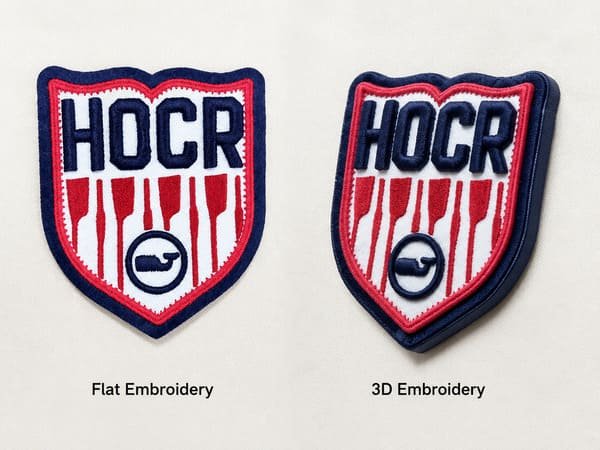
Choose 3D embroidery when specific parts of your design need noticeable depth and emphasis.
Applique Patches — Best for Large Areas and Special Fabric Effects
Applique allows another fabric to become part of the artwork itself.
If you have a large patch and do not want the entire surface to be filled with embroidery thread, applique gives you another option. You can choose a fabric you like—such as denim, twill, plush fabric or leopard-pattern velvet—to cover selected areas and create a different texture and visual effect.
It works particularly well for:
- large-area coverage
- special fabric textures
- surface effects that thread alone cannot create
Materials such as plush or patterned fabrics can become part of the visual concept rather than simply acting as a background.
Choose applique when material texture and layered textile effects are important parts of the design.
Sequin Patches — Best for Decorative and High-Impact Designs
Sequin patches are primarily about visual impact.
They are commonly used for cheerleading uniforms, performance clothing, children’s backpacks and other products where a brighter, more decorative appearance is wanted.
We can customize patches using different sequin sizes. The smallest sequin size we currently support is approximately 2.2 mm.
Very small graphic elements may therefore need another technique. Sequin can also be combined with embroidery when a design needs both decorative shine and finer details.
Choose sequin when decorative shine and strong visual impact are central to the design.
How to Choose the Right Custom Patch Type for Your Design
Once you understand the main patch types, the next step is to look at your own design. Where will you use the patch, how detailed is the artwork, and what kind of finished look do you want?
Start With Where the Patch Will Be Used
Where you plan to use the patch can quickly narrow down the most suitable options. Different products place different demands on texture, appearance and performance.
For example, PVC is often a practical choice for camping backpacks and outdoor gear, while chenille naturally suits varsity jackets and team apparel where a bold, lively look is wanted. Leather can work especially well on denim, workwear, hats and outdoor products where the material itself supports the overall style.
Before choosing a patch type, first ask yourself: where will this patch actually be used?
Look at the Smallest Details in Your Artwork
Do not judge only the overall logo.
The smallest element can determine whether a process is suitable.
Look closely at:
- the thinnest line
- the narrowest graphic element
- the most detailed area
The table below summarizes the minimum achievable dimensions in our current production.
| Process | Minimum Achievable Dimension |
|---|---|
| Embroidery — Single-Line Stitch | About 0.3 mm width |
| Embroidery — Zigzag Stitch | About 1 mm width |
| PVC Detail | About 1.5 mm width |
| 3D Embroidery Detail | About 2 mm width |
| Chenille Detail | About 5 mm width |
| Sequin | About 2.2 mm minimum diameter |
| Adjacent Sequin Overlap | About 1.1 mm minimum spacing |
Check Whether the Patch Is Simply Too Small
In some cases, if the finished patch does not look balanced, the problem may not be the patch type itself. The artwork may simply be too small for the number of elements it contains, making important details difficult to reproduce clearly and leaving the overall design looking crowded or unbalanced
In this situation, increasing the finished size may solve the problem without changing the patch type.
Before changing techniques, ask:
Would the design work better if the patch were slightly larger?
Compare Samples When More Than One Patch Type Works
Sometimes more than one process can produce the same logo successfully.
The difference then becomes more about the finished appearance and feel.
For example, the same design may appear:
- more textured in embroidery
- smoother and lighter in woven
- more color-driven in sublimation
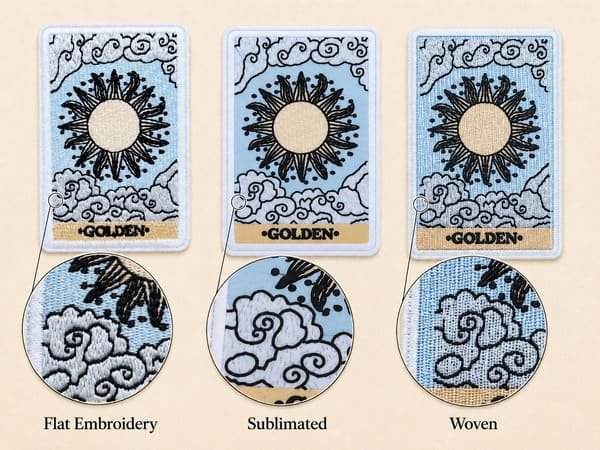
If you are unsure which option suits your design better, you can ask us to make samples in different techniques so you can compare the actual results before making your final decision.
A digital mock-up cannot fully show surface texture, thickness, softness or dimensional depth.
By comparing real samples with us, you can choose the finished look that truly matches what you want.
When Should You Combine Different Patch Techniques?
Sometimes one technique cannot provide every effect a design needs.
In these cases, combining processes can produce a better result.
Chenille + Embroidery
Chenille can create the large, fuzzy areas and visual volume, while embroidery handles smaller elements such as outlines, facial features, symbols or text.
This allows each technique to work in the area where it performs best.
Applique + Embroidery
Appliqué introduces a special textile surface, while embroidery defines edges, text and smaller graphic details.
This is useful when the fabric itself needs to become part of the design rather than simply serving as a base.
Printing, Sequin and Other Hybrid Combinations
Some of the most popular technique combinations in our factory include:
- Printing + Embroidery
- Sequin + Chenille
- Sequin + Chenille + Embroidery
You can also combine different techniques based on your own artwork to create a patch that feels truly unique to your design.
It is to let each part of the artwork use the technique best suited to its visual needs.
Common Mistakes When Choosing a Custom Patch Type
Choosing a Patch Type Only Because You Like the Look
A patch style that looks attractive in one design may not suit another.
For example, chenille may look excellent on a large varsity letter but may not be appropriate for a small logo filled with narrow text.
Start with your own artwork, finished size and application, then decide which visual style fits those requirements.
When One Technique May Not Be Enough
Another mistake is assuming that every part of a patch must use the same technique.
One technique may work very well for the main area of your design, while another may reproduce the smaller details more clearly.
For example, chenille can handle a large fuzzy body while embroidery handles facial features. Appliqué can provide a special textile surface while embroidery adds smaller graphic elements.
When different parts of your artwork need different effects, combining techniques allows each area to use the process that suits it best.
Which Custom Patch Type Is Right for You?
There is no universal best custom patch type.
From our production experience, the most important factors are where the patch will be used, what the artwork looks like, and what visual or tactile effect you want to achieve.
- Choose embroidery for visible stitched texture.
- Choose woven for fine details and a lightweight surface.
- Choose sublimation for full color, gradients and photo-like artwork.
- Choose PVC for outdoor performance and molded depth.
- Choose chenille for bold varsity volume.
- Choose leather when material character is part of the brand identity.
- Choose 3D embroidery when selected areas need stronger depth.
- Choose applique when a special textile surface is part of the design.
- Choose sequin when decorative shine is the priority.
The best patch type is not necessarily the most expensive or complicated one.
It is the one that allows your artwork to achieve the intended effect at the finished size and in the intended application.
If you are unsure which patch type to choose, send us your artwork, intended application, preferred size and the finished look you want. We can review the details with you and explain which options are realistic for your design. Using our extensive production experience, we’ll recommend the most suitable technique or combination of techniques for your specific project.
Frequently Asked Questions About Custom Patch Types
No.Woven emphasizes thinness and fine detail, while embroidery emphasizes visible stitching, texture and depth.
The better option depends on the appearance you want.
Yes. Different techniques can be combined when separate areas of the artwork have different requirements.
The purpose is not to use more processes, but to use the most suitable process for each part of the design.
If two techniques can both reproduce the artwork but create noticeably different results, comparing physical samples can be useful.
A sample makes it easier to judge differences in texture, thickness, softness and depth that a digital mock-up cannot fully show.
The goal is to determine which version most closely matches the finished product you want to create.
Yes. A design that works well at a larger size may lose important details when made much smaller. Before changing the patch type, we may first suggest adjusting the finished size so your original design can be reproduced more clearly.