
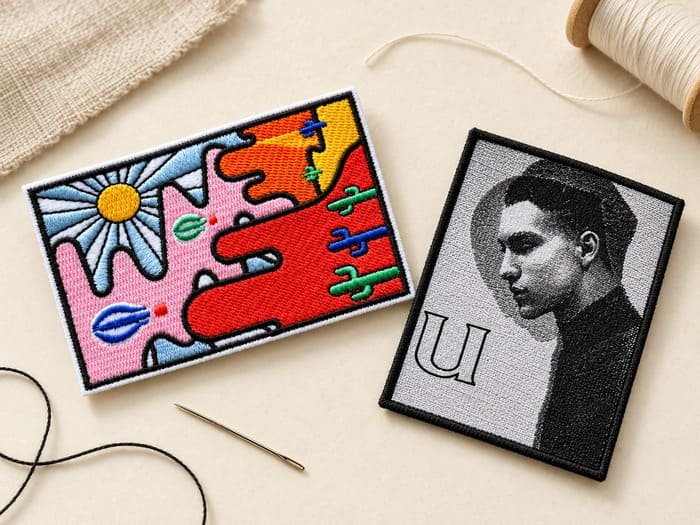
Your logo may work as either an embroidered or a woven patch, but which finish suits it best? Embroidered patches offer a more pronounced stitched texture, while woven patches have a flatter surface that generally accommodates finer detail. We’ll compare how the two look, feel, and perform so you can choose the right option for your design and where you plan to use it.
| Feature | Embroidered Patches | Woven Patches |
|---|---|---|
| How the Design Is Made | Thread is stitched onto a fabric base. | The design is woven into the fabric itself. |
| Surface Texture | More pronounced stitch texture and a raised finish. | A flatter, smoother surface with a finer woven texture. |
| Small Text and Fine Detail | Fine details are possible, but small lettering and narrow gaps need careful review. | Generally accommodates smaller details and finer lettering at the same finished size. |
| Thickness and Flexibility | Typically thicker and more structured; the fabric base and stitching affect the feel. | Typically thinner and more flexible with comparable finishing. |
| Durability | Holds up well with normal use and appropriate care. | Holds up well with normal use and appropriate care. |
| Cost Considerations | Often similarly priced in our projects; artwork complexity and order specifications affect the quote. | Often similarly priced in our projects; artwork complexity and order specifications affect the quote. |
Thickness and flexibility also depend on the backing and finishing you choose.
How Are Embroidered and Woven Patches Made?
Embroidered Patches: Stitches on a Fabric Base
An embroidered patch starts with a base fabric, often twill. Colored threads are stitched onto that fabric to create the lettering, shapes, and background areas.
The base can remain visible as part of the design or be covered with stitching. Different stitch directions give the surface its characteristic texture, so you can often see and feel individual sections of the artwork.
Woven Patches: Designs Woven into the Fabric
Woven patches are made by interlacing threads on a loom. The thread colors form the lettering, shapes, and background as the fabric is woven.
Unlike embroidery, which adds stitches to a fabric base, weaving forms the fabric and design together. This generally gives woven patches a flatter, thinner, and more flexible feel, although the backing and edge treatment also affect the finished result.
Appearance and Detail: Embroidered vs Woven Patches
Surface Texture: Visible Stitches or a Flatter Finish?
Embroidery gives your design visible stitch direction and a raised surface. Broad lettering and simple shapes can make good use of that texture, with different sections catching the light as the patch moves.
Woven patches have a smoother surface, where the image is formed within the weave. The overall effect is more even, although you can still see the textile structure up close.
Neither finish is automatically more professional or higher quality. The choice depends on whether you want the stitching itself to be part of the visual effect.
Small Text and Fine Lines: Which Looks Clearer?
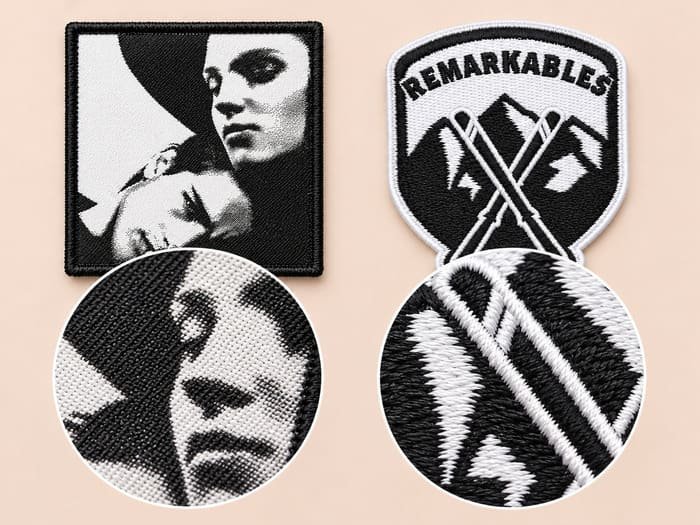
At the same finished size, woven patches generally accommodate smaller lettering and finer lines than standard embroidered patches. This can make woven a good choice when your design includes small details that need to remain distinct.
In our production work, however, we find that both styles need enough space for the design to read clearly. Artwork that looks impressive when enlarged on screen can appear crowded or lose definition when too many fine details are packed into a small patch. Check the design at its intended finished size, especially the smallest lettering and the gaps between shapes.
If the size is fixed and the intricate artwork needs to be preserved, sublimated patches may be worth considering. Printing can reproduce fine details and color transitions without building each element from thread, although very small text still needs to be checked for readability.
Finished Size: How Does It Affect Your Choice?
The same artwork may suit embroidery at a larger size but benefit from weaving when reduced. Your intended patch size can therefore influence which style works best, especially when the design needs to fit a limited space on a cap, sleeve, or bag.
If the available space allows, a larger patch may help preserve the details you want in embroidery. If the dimensions are fixed, compare how both styles reproduce the essential elements at that size. A smaller patch does not automatically require weaving; a simple, well-spaced design may work well in either style.
Wear and Durability: How Do They Compare?
Feel and Fit on Clothing or Gear
Woven patch faces are generally flatter and more flexible, while embroidered faces have a more noticeable stitched surface and body. That difference can affect how the patch feels and sits on the item.
On lightweight clothing, you may prefer a less prominent patch. On a structured cap or jacket, the texture of embroidery may be part of the look you want. The location and size matter as much as the general product category.
Choose the attachment method according to the item’s fabric, placement, and use. Choose the attachment method to suit the fabric, patch placement, and how the item will be used.
Snagging, Edge Wear, and Washing
An embroidered surface has exposed stitches that can catch against rough objects. Woven patches have less raised stitching across the face, but their finer construction does not make them immune to abrasion or edge damage.
For both styles, durability depends on the thread, construction, edge finish, attachment, and conditions of use. A thicker patch is not automatically the longer-lasting one, and a thinner patch is not automatically fragile.
If your patches will face frequent washing or repeated friction, discuss those conditions before production. Follow care instructions for the complete patch and garment, and use relevant test results to assess demanding applications rather than relying only on the words “embroidered” or “woven.”
Are Woven Patches Cheaper Than Embroidered Patches?
What Affects the Cost of Each Style?
In our projects, embroidered and woven patches are often similarly priced when the size, quantity, and finishing requirements are comparable. The final quote depends on the artwork and production specifications.
For embroidered patches, the size, stitch count, coverage, and production requirements can affect the cost. A design with a large stitched background may involve different work from one that leaves much of the base fabric exposed.
For woven patches, the weaving specifications, colors, size, setup, and order quantity also matter. Cutting, borders, backing, and other finishing requirements contribute to the finished price for either style.
Compare Quotes Using the Same Specifications
For a useful comparison, keep the artwork, finished dimensions, quantity, edge finish, and backing requirements consistent wherever possible.
Also check what each quotation includes, such as setup, samples, and delivery. If the embroidered version needs larger lettering or a simplified layout, make sure you understand those changes before comparing the prices.
The aim is to compare two acceptable versions of your design. A lower price is less useful if the patch no longer includes the information or appearance you need.
Which Patch Style Should You Choose?
Choose Embroidery When Texture Is the Priority
Consider embroidery when visible stitching is an important part of your design. Bold lettering, clear symbols, and open shapes can give the stitches enough room to create a distinct texture.
A simple logo does not need to become more detailed to look effective. If you like its embroidered appearance and it remains clear at the required size, weaving may offer a different finish without necessarily improving the result.
Choose Woven When Fine Detail Is the Priority
Consider woven patches when the design must retain small lettering, fine outlines, or several closely spaced elements within a limited area.
For example, a badge with a short tagline beneath its main logo may benefit from woven construction if that tagline must remain readable at a small size. Confirm the result on a sample rather than assuming that every detail in the original file will transfer unchanged.
If You Prefer Embroidery, Can the Artwork Be Adjusted?
Sometimes you can keep the embroidered finish by making a few controlled changes:
- Increase the overall patch size.
- Use a more open or heavier font.
- Increase spacing between letters or nearby shapes.
- Simplify secondary details that are not essential to recognition.
Any change to wording, logos, or important design elements should be agreed upon before production.
If both styles remain suitable, compare physical samples at the same size. Look at them from the distance at which the patch will normally be seen, as well as up close.
Frequently Asked Questions
They use related weaving methods, but the finished products are often configured for different purposes. Woven labels may have folds for sewing into garments, while woven patches are typically finished as badges with a defined outline and suitable attachment option.
Yes, a woven patch can have a stitched border, such as a suitable merrowed or embroidered edge. The border does not change how the central design is made, so use the patch face—not just its outline—to identify the construction.
Yes, both styles can be produced with suitable attachment options. Choose the backing for the garment or gear and how you plan to use the patch; it is a separate decision from the face construction.
Yes, a patch can combine a woven design with selected embroidered elements. This can bring together fine detail and raised stitching, but the layout and additional production work should be assessed for the specific design.
Need Help Choosing Between Embroidered and Woven Patches?
Send us your artwork, preferred patch size, quantity, and where you plan to use it. At SML PATCH, we’ll help you compare embroidered and woven options and explain any design adjustments before production. Tell us what matters most to you: a pronounced stitched texture, clear fine details, or a balance of both.